With the presence of the esteemed President, the Think Tank of Universities and the Network for Public Policy Studies has commenced its work.
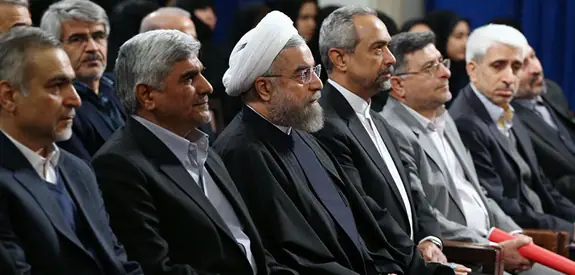
According to the public relations office of Qom University of Technology: At the closing ceremony of the seventh international Farabi festival held in the Shahid Beheshti hall of the presidency on Sunday, February 11, 1393 (February 10, 2015), in the presence of Hojjatoleslam and Muslims Dr. Hassan Rouhani, the President, Mohammad Farhadi, the Minister of Science, Research and Technology, Seyed Zia Hashemi, the Deputy for Cultural and Social Affairs of the Ministry of Science, Research and Technology, provincial think tank directors, researchers, and activists in the field of humanities and Islam, the network of provincial think tanks of universities and the network of public policy studies began their work.
It is noteworthy that the website "Public Policy Studies Network" was launched by the Center for Strategic Studies of the presidency with the aim of increasing the participation of the country’s elites in public policy-making and enhancing the level of social dialogue for the efficiency and quality of the country’s public policies. Among the programs of this network is the publication of texts produced by the "Provincial Think Tank Network." The provincial think tanks across the country have been established in collaboration with the Center for Strategic Studies and the Cultural and Social Deputy of the Ministry of Science, Research and Technology at the mother universities of the provinces, which in Qom Province this responsibility has been entrusted to Dr. Mohammad Sadegh Akhoondi, the head of Qom University of Technology.
On the sidelines of this event, Dr. Akhoondi emphasized that the main responsibility of provincial think tanks is to attract the participation of elites in the provinces in provincial dialogues to address issues and problems and provide suitable solutions. He added: The President has always asked elites and intellectuals to participate in the administration of the country's affairs. The establishment of the public policy studies network and the establishment of provincial think tanks at universities has also been with this approach, which will bring about increased tri-sectoral interaction among elites and social, academic, and governmental activists. At the end, Dr. Akhoondi invited all professors of universities in the province and also social and cultural activists of Qom Province to actively participate in the university think tank of Qom Province, noting that further details of the activities and programs of the university think tank in Qom Province will be communicated in the near future through a press conference with media representatives and news agencies.