
Heat Transfer Laboratory
Heat Transfer Laboratory
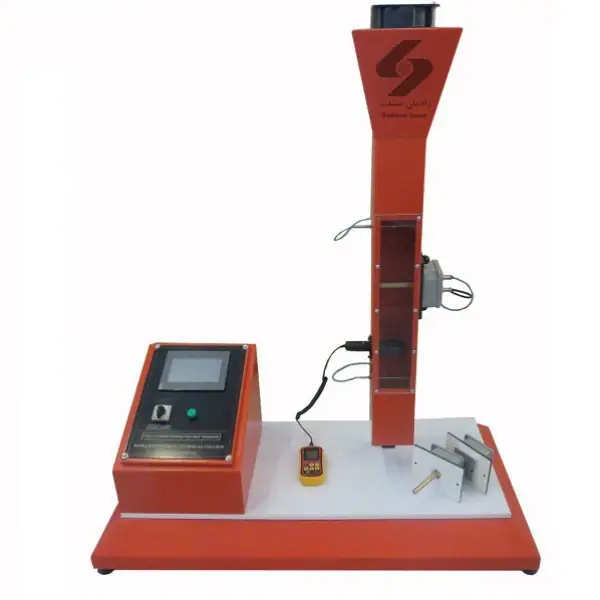
Free and Forced Convection
Convection is one of the three fundamental modes of heat transfer. Heat transfer by convection occurs in two forms: free (natural) convection and forced convection.
Free convection results from density differences caused by temperature variations, where fluid motion is driven by buoyancy forces. Consequently, free convection cannot occur in the absence of gravity. In contrast, forced convection occurs when fluid motion is generated by external means such as a fan or airflow.
Convective heat transfer depends on several fluid properties and operating conditions, including fluid velocity, density, thermal conductivity (k), and dynamic viscosity.
This experimental apparatus enables students to investigate both free and forced convection using different types of test specimens, providing a practical understanding of the underlying heat transfer mechanisms.
Experiments
The following experiments can be performed using this apparatus:
-
Investigation of free and forced convection over flat plate and cylindrical rod test specimens.
-
Study of the relationship between air velocity and surface temperature under both free and forced convection conditions.
-
Determination of the convective heat transfer coefficient, thermal efficiency, and heat transfer rate.
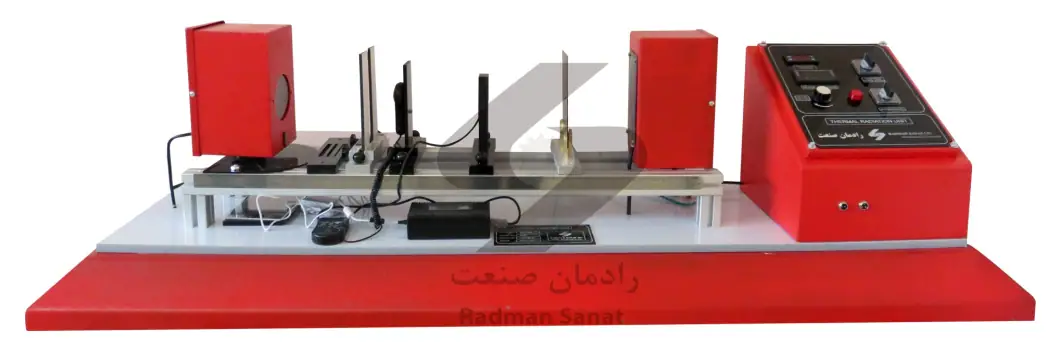
Thermal Radiation Apparatus
Thermal radiation is one of the three fundamental modes of heat transfer and differs significantly from the other two mechanisms, conduction and convection. Unlike conduction and convection, radiative heat transfer can occur in a vacuum and does not require a material medium for energy transfer.
Radiative heat transfer plays a vital role in many industrial applications, particularly in industrial furnaces, heating and cooling systems, industrial drying processes, and energy conversion systems such as fossil fuel combustion and solar radiation.
The laboratory apparatus is equipped with an adjustable heat and light source, along with a set of interchangeable color filters, enabling students to perform a wide range of radiation heat transfer experiments.
Experiments
The following experiments can be conducted using this apparatus:
-
Investigation of the fundamental laws governing thermal radiation using two different heat and light sources.
-
Study of the effect of the relative orientation of opposing surfaces on radiative heat transfer.
-
Determination of the emissivity of various surfaces.
-
Determination of the view factor (shape factor) in radiative heat transfer.
-
Verification of Lambert's Cosine Law.
-
Experimental determination of the Stefan–Boltzmann constant.
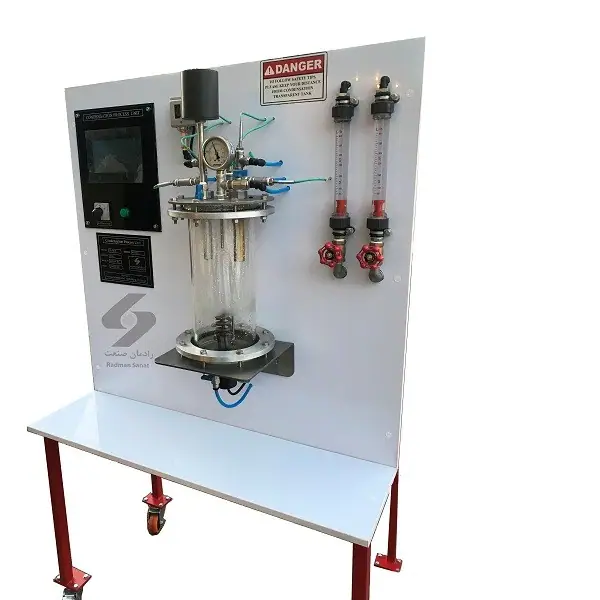
Condensation Apparatus
Condensation occurs when vapor comes into contact with a surface whose temperature is below the vapor's saturation temperature. As the vapor condenses, the resulting liquid wets the surface and flows downward under the influence of gravity. Depending on the surface wettability, condensation occurs in one of two forms: filmwise condensation or dropwise condensation.
In filmwise condensation, the condensate completely wets the solid surface, forming a continuous liquid film. In dropwise condensation, however, the condensate does not spread uniformly over the surface but instead forms discrete droplets.
This apparatus is designed to provide a simple and effective demonstration of both condensation modes. It consists of a transparent glass chamber containing a heating element and the working fluid. Two vertically mounted condensers are installed inside the chamber, allowing students to observe filmwise and dropwise condensation simultaneously.
Experiments
The following experiments can be performed using this apparatus:
-
Investigation of conductive heat transfer during the condensation process.
-
Study of heat transfer characteristics during condensation.
-
Investigation of the effects of temperature and pressure on the condensation process.
-
Observation and comparison of filmwise and dropwise condensation.
-
Determination of the heat transfer coefficient during condensation.
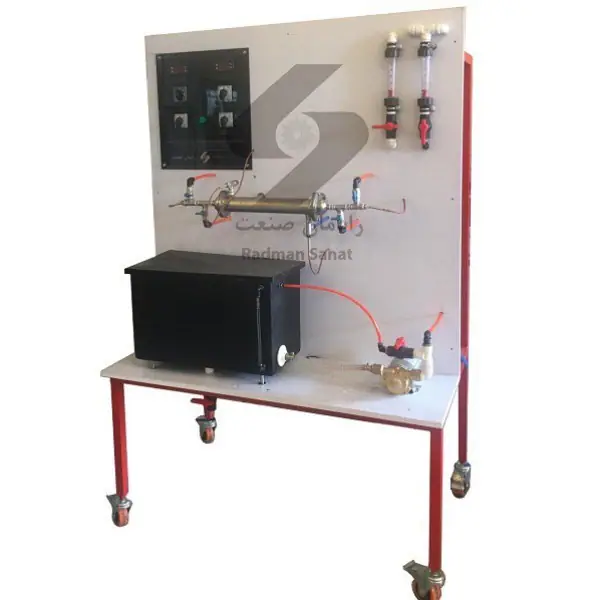
Shell-and-Tube Heat Exchanger
The shell-and-tube heat exchanger is the most widely used type of heat exchanger in industry. It is manufactured in a wide range of sizes and configurations to meet diverse industrial requirements. These heat exchangers are commonly used for liquid evaporation, vapor condensation, and heat transfer between two fluids.
A shell-and-tube heat exchanger consists of a bundle of tubes carrying one fluid, while a second fluid flows around the outside of the tubes within the shell. Heat is transferred through the tube walls, which serve as the heat transfer surface separating the two fluids.
Experiments
The following experiments can be performed using this system:
-
Introduction to heat transfer processes in shell-and-tube heat exchangers.
-
Investigation of the effects of parallel-flow and counter-flow configurations on heat transfer performance.
-
Determination of the overall heat transfer coefficient and thermal efficiency of shell-and-tube heat exchangers.
-
Analysis of the energy balance in shell-and-tube heat exchangers.
-
Estimation of heat losses and investigation of the effect of flow rate on heat transfer performance.
-
Comparison of shell-and-tube heat exchangers with other types of heat exchangers.
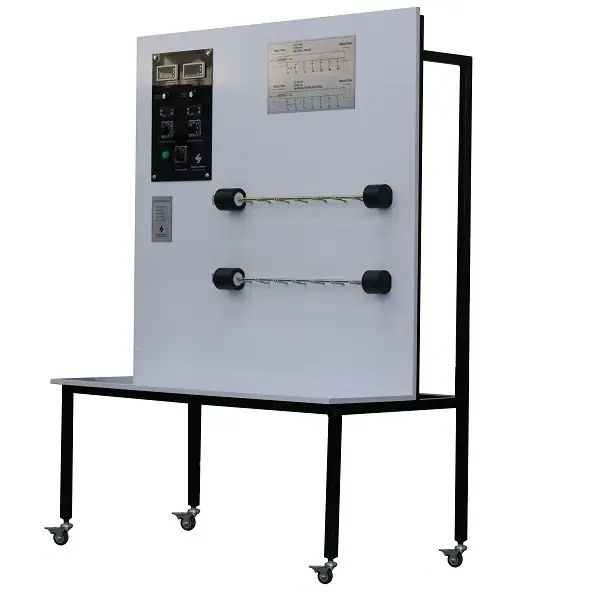
Extended Surfaces (Fins)
The study of extended surfaces (fins) focuses on the analysis of temperature distribution and heat transfer by conduction within a solid, as well as heat transfer by convection and radiation from the fin surface to the surrounding environment. The direction of heat transfer from the fin surface is perpendicular to the primary direction of heat conduction along the fin.
For a given fin, the temperature gradient depends on the thermal conductivity of the fin material and the rate of heat loss to the surrounding environment. This experimental apparatus provides an effective means of investigating the influence of fin material and base temperature on temperature distribution and heat transfer characteristics.
Experiments
The following experiments can be performed using this system:
-
Investigation of the effect of fin material on temperature distribution and heat transfer performance.
-
Investigation of the effect of base temperature on temperature distribution and heat transfer performance.
Thermal Conductivity of Fluids
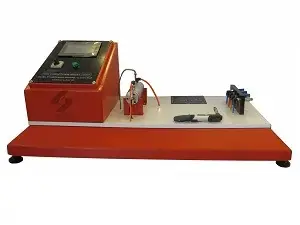
When a temperature gradient exists within a material, thermal energy is transferred from the region of higher temperature to the region of lower temperature. In solids, this transfer occurs through thermal conduction, which results from molecular interactions. The temperature at any point depends on the energy of the surrounding molecules, and heat is conducted in the direction of decreasing temperature.
A similar mechanism occurs in fluids. However, because fluid molecules are generally closer together and interact differently than in gases, the conduction process exhibits distinct characteristics.
This apparatus is specifically designed to measure the thermal conductivity of fluids while minimizing the effects of natural convection and thermal radiation. By maintaining a very narrow gap between two cylindrical elements, convective heat transfer becomes negligible. Furthermore, the use of relatively low operating temperatures and polished surfaces significantly reduces radiative heat transfer.
The system consists of three concentric cylindrical layers. A heating element is located in the innermost cylinder, cooling water flows through the outermost cylinder, and the test fluid is confined within the intermediate annular space. This configuration enables accurate determination of the thermal conductivity of the working fluid.
Experiments
The following experiments can be performed using this system:
-
Investigation of the fundamental principles governing heat conduction.
-
Measurement of the thermal conductivity of air.
Heat Conduction in Solids
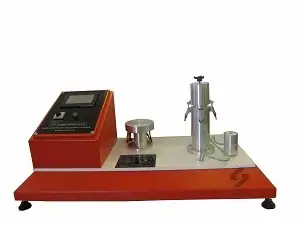
Heat transfer by conduction occurs within a solid when a temperature gradient exists between two points. The greater the temperature gradient, the higher the rate of heat transfer. Conduction is the transfer of thermal energy from higher-energy particles to lower-energy particles through molecular and atomic interactions.
In solids, heat conduction occurs primarily through lattice vibrations and molecular interactions. Although conduction takes place in solids, liquids, and gases, it is most effective in solids because their molecules are more closely packed, allowing thermal energy to be transferred more efficiently.
This experimental apparatus enables students to determine the thermal conductivity of solid materials using both linear (axial) and radial heat conduction models. Both sections are equipped with thermocouples that measure temperatures at various locations with an accuracy of ±0.1°C. Heat is supplied by an electric heating element at the hot end, while cooling water is circulated through the cold end to establish a steady temperature gradient.
Experiments
The following experiments can be performed using this system:
-
Investigation of the effect of contact surfaces on conductive heat transfer in solids.
-
Investigation of the influence of material properties on conductive heat transfer.
-
Plotting linear and radial temperature distribution profiles.
-
Determination of the thermal conductivity of solid materials using axial and radial conduction models.
Heat Transfer Laboratory Manual